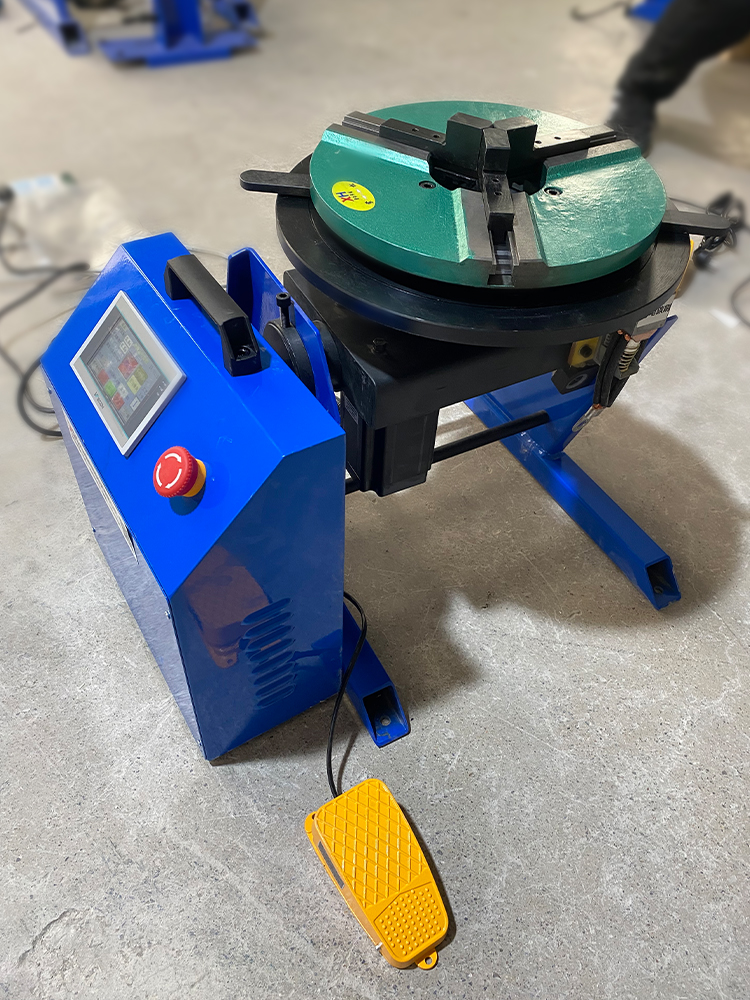
I. Mechanical Structure Failures
| Symptom | Possible Causes | Solution |
|---|---|---|
| 1. Jerky or Sticky Rotation/Tilting | ① Insufficient lubrication or severe wear of guides/bearings; ② Excessive gear/chain backlash or foreign material; ③ Workpiece exceeds rated load | ① Clean and lubricate guides/bearings with recommended oil (e.g., lithium grease); replace if worn; ② Clear debris, adjust meshing clearance, and tension chains; ③ Verify load weight; use a higher-capacity positioner or process in batches |
| 2. Table Wobbling or Poor Positioning | ① Loose anchor bolts (vibration-induced); ② Loose table mounting bolts; ③ Axial/radial shaft play | ① Retighten anchor bolts to spec with torque wrench; use lock washers; ② Inspect and tighten all connecting bolts; ③ Check bearings and lock nuts; replace worn parts and adjust preload |
| 3. Abnormal Noise (Screeching/grinding) | ① Dry friction due to lack of lubrication; ② Worn or damaged gears/chain; ③ Bearing failure | ① Lubricate moving parts and recheck; ② Inspect transmission components; replace if worn or damaged; ③ Examine bearings; replace if faulty (ensure alignment during installation) |
II. Drive System Failures
(Power-related; often involves motor and gearbox)
The drive system supplies motion power. Common symptoms include failure to move, weak output, or irregular speed.
1. Motor Issues
| Symptom | Possible Causes | Solution |
|---|---|---|
| ① No Response on Startup | ① Power loss (tripped breaker, loose plug); ② Wiring fault or poor connection; ③ Overload trip | ① Check power supply and reset breaker; ② Test wiring continuity; repair or reconnect; ③ Allow cooling; reset thermal relay. Investigate if recurring |
| ② Irregular Speed | ① VFD parameter error; ② Incorrect DC voltage; ③ Motor winding short | ① Reconfigure VFD per manual guidelines; ② Verify DC supply voltage; ③ Test windings; repair or replace motor |
| ③ Overheating | ① Excessive load; ② Blocked or faulty cooling; ③ Worn bearings | ① Reduce load to rated value; ② Clean or replace fan and vents; ③ Replace bearings and relubricate |
2. Gearbox Issues
Symptom: Oil leakage, low output torque, unusual noise
Causes: ① Worn seals; ② Low/ degraded oil; ③ Gear damage
Solutions:
① Replace seals and apply sealant;
② Drain and refill with approved gear oil (e.g., N320 EP oil) to correct level;
③ Inspect gears; repair or replace gearbox as needed.
III. Control System Failures
(Command and sensing-related; involves electrical components)
Control system includes operator panel, sensors, and controllers. Failures often lead to unresponsive commands, positioning errors, or erratic behavior.
| Symptom | Possible Causes | Solution |
|---|---|---|
| 1. No Response from Controls | ① Dirty/oxidized contacts; ② Loose wiring; ③ Blown fuse | ① Clean contacts with alcohol or replace parts; ② Tighten all terminals; ③ Locate and replace fuse (after短路 check) |
| 2. Positioning Inaccuracy | ① Faulty sensor (encoder, prox switch); ② Sensor misalignment; ③ Parameter drift | ① Test sensor signal; replace if faulty; ② Realign sensor and trigger; ③ Recalibrate positioning parameters in PLC/VFD |
| 3. Unintended Operation (e.g., random stop/start) | ① Electrical interference; ② Incorrect wiring; ③ PLC failure | ① Improve grounding (R≤4Ω), shield cables, separate signal/power lines; ② Review wiring diagram and correct errors; ③ Check PLC I/O; restart or replace module |
IV. Daily Maintenance Recommendations
Routine maintenance is essential to minimize failures and extend service life:
- Lubrication:
Apply grease to guides and bearings weekly.
Check gearbox oil monthly; change every 3–6 months. - Cleaning:
Remove weld spatter and dust daily from table and mechanical parts. - Load Management:
Always verify workpiece weight before operation. Avoid overloading. - Electrical Inspection:
Monthly checks of terminals, fuses, and sensor connections for tightness and corrosion. - Fault Documentation:
Maintain a log with details of faults and resolutions to support future diagnostics.